
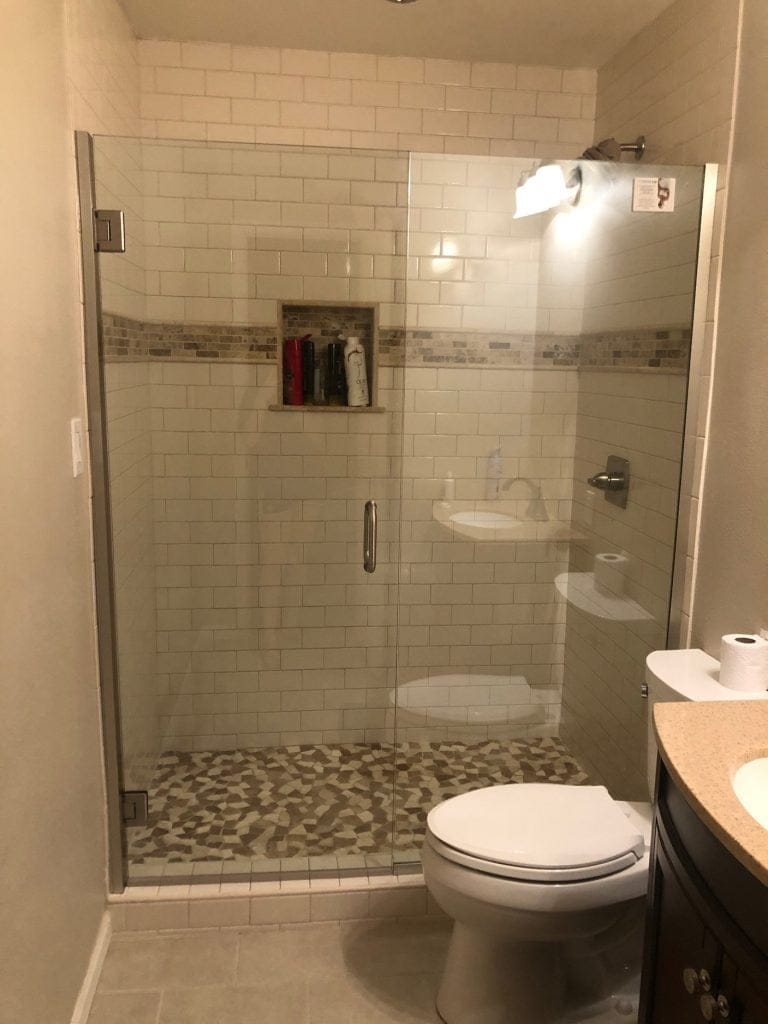
Frameless shower doors are one of the few remodel decisions where the visual difference is obvious and the practical differences are not. Everyone can see that a frameless enclosure looks more open. Fewer people know that the three styles differ in water containment, cleaning effort, installation requirements, and what happens if the glass ever needs replacing.
Here is an honest comparison of framed, semi-frameless, and frameless enclosures, so you can weigh more than the showroom photo.
The Three Styles
Framed
Metal framing surrounds every glass panel and the door itself. The frame carries the structural load, which means the glass can be thinner — typically around 3/16 of an inch. The frame also holds the alignment, so the enclosure tolerates walls that are not perfectly plumb.
Semi-Frameless
The perimeter is framed but the door edges are not, or the framing is reduced to the minimum needed structurally. Glass is usually a bit thicker than a framed unit. This is the middle option in both appearance and price, and it is often the practical answer in a bathroom where the framed look feels dated but a full frameless build is not in the budget.
Frameless
No perimeter framing. Heavy tempered glass — commonly 3/8 or 1/2 inch — carries its own weight, supported by hinges and clips mounted into the wall. The glass thickness is not a style choice; it is structurally required once you remove the frame.
Cleaning: The Difference People Actually Feel
This is the practical advantage that comes up most often after installation, and it is real. Framed enclosures have a metal channel along the bottom and up the sides. That channel collects water, soap residue, and eventually mildew, and it is awkward to clean because you cannot easily reach into it. Over years, that track is the part of the shower that starts to look permanently grubby no matter how often you scrub.
A frameless enclosure is mostly flat glass with a few hardware points. There is far less geometry for residue to hide in. That does not make it self-cleaning — glass in a hard-water area still needs regular attention, and our guide to keeping glass clean and streak-free applies directly to shower glass. But there is genuinely less to clean.
Hard Water Is the Real Enemy
Whatever style you choose, mineral deposits are what ruin shower glass over time. Water dries on the surface and leaves minerals behind, which etch into the glass and eventually cannot be polished off. A squeegee after each shower is the single most effective habit, and it matters more than the style you pick. Protective coatings can help, though they wear and need periodic reapplication — ask what the realistic reapplication interval is before treating it as permanent.
Water Containment: The Honest Trade-Off
This is where frameless has a genuine disadvantage that showroom displays do not communicate. A framed enclosure has gaskets and channels at every edge, engineered specifically to keep water inside. A frameless enclosure has deliberate small gaps at the hinge side and around the door edge.
A well-designed frameless enclosure manages this through slope, door swing direction, and the position of the shower head — and in a properly designed installation, water stays where it should. But it is less forgiving of design mistakes. If the shower head sprays directly at the door gap, or the curb does not pitch inward correctly, you will get water on the bathroom floor. In a wet room or a large walk-in with the fixtures well away from the opening, this is rarely an issue. In a compact enclosure with a handheld sprayer, it needs thought.
Installation Realities
Frameless enclosures require solid blocking in the wall to carry the hardware. Heavy glass hanging on hinges puts real load into a few small points, and hollow drywall will not hold it. If your remodel has not started, this is worth raising with your contractor now — adding blocking before the tile goes up is trivial, and adding it after is not.
The other installation reality is measurement. Tempered glass cannot be cut, drilled, or adjusted after it is tempered, so every dimension and every hole has to be exact before fabrication. That is why a frameless enclosure is measured after tile is set, not from plans, and why the lead time is longer than a stock framed unit you could theoretically pick up the same day.
Out-of-Plumb Walls
Framed enclosures hide a surprising amount of imperfection inside the frame. Frameless enclosures do not — a wall that leans shows up as an uneven gap along the glass edge. In an older Palestine home, this is worth knowing about before you commit, because it may mean either accepting a visible variance or correcting the wall.
Cost, Realistically
Framed is the least expensive, semi-frameless sits in the middle, and frameless is meaningfully more. The gap is driven by material and labor together: frameless uses two to three times the glass thickness, requires heavier hardware, needs precise field measurement, and takes longer to install safely because the panels are heavy and awkward.
We are not going to quote numbers here, because enclosure pricing depends entirely on the dimensions, the configuration, the hardware finish, and the condition of the walls. Anyone giving you a firm price without measurements is guessing. What we can say is that the relative ordering holds consistently, and the difference is large enough to be a real budget decision rather than a rounding error.
Which One Fits Your Bathroom
- Small bathroom where openness matters visually: frameless or semi-frameless makes the room read larger.
- Tight enclosure with a handheld sprayer: framed or semi-frameless contains water more reliably.
- Rental or resale-focused update on a budget: framed does the job and holds up.
- Hard-water area with people who will not squeegee: fewer channels means frameless ages better, but expect to manage deposits either way.
- Older home with out-of-plumb walls and no budget for correction: framed forgives what frameless reveals.
Clear Choice Glass Can Help With Your Shower Enclosure
Shower glass is a decision you live with daily for a long time, and the right answer depends on your specific bathroom — the dimensions, the fixture layout, the wall condition, and how you actually use the space. That is a conversation worth having before the tile goes up, not after.
Clear Choice Glass and Mirror serves homeowners in Palestine, TX, and the surrounding area. Contact Clear Choice Glass to talk through your bathroom project, or call 903-727-0425 to get started.