
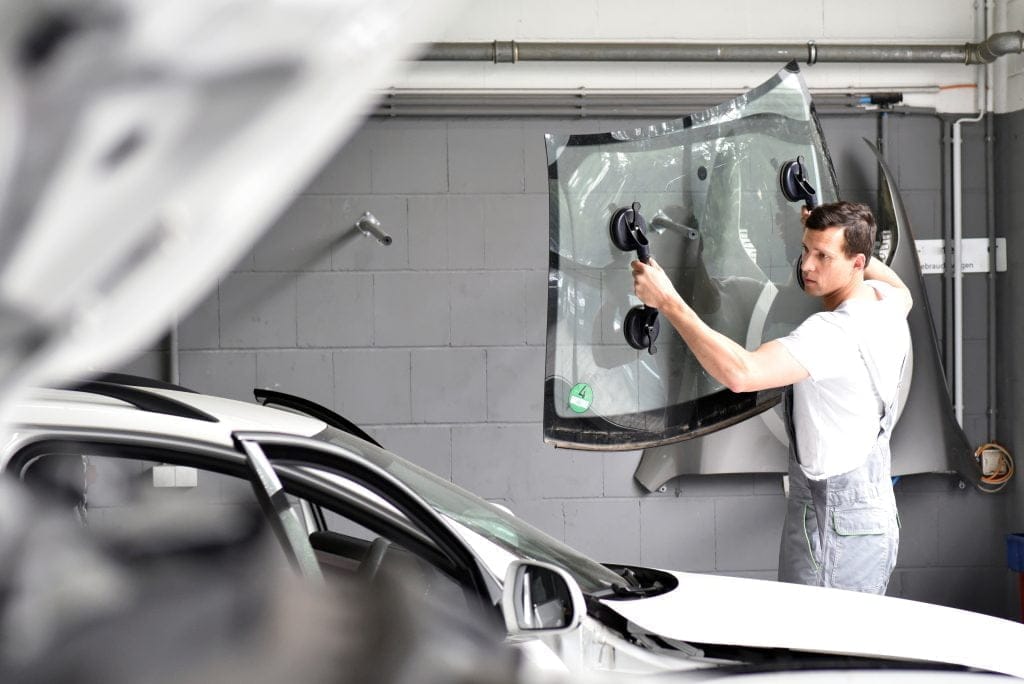
A windshield replacement is quick — often an hour or two from start to finish. What takes longer is the adhesive. The urethane holding your new windshield to the vehicle body is still curing when you drive away, and how you treat the car over the next two days has a real effect on how well that bond sets.
None of this is complicated. But it is the part drivers most often get wrong, usually because nobody explained why it matters.
Why the Adhesive Matters More Than the Glass
Your windshield is not a window that happens to be at the front of the car. It is a structural component. It contributes to the rigidity of the passenger compartment in a rollover, and on most vehicles the passenger airbag deploys upward against the windshield, using it as a backstop to direct the bag toward the occupant. If the glass separates from the body, the airbag pushes out through the opening instead.
All of that depends on the urethane bead around the perimeter. Fresh out of the tube it is strong enough to hold the glass in place, but it needs time to fully cross-link and reach its designed strength. That interval is the safe drive-away time, and it varies by adhesive product, temperature, and humidity — which is why your technician should tell you a specific number rather than a generic one.
Ask for Your Number Before You Leave
Do not guess and do not assume it is the same as a friend’s. Ask what the safe drive-away time is for the adhesive used on your vehicle today, in today’s conditions, and wait it out. In East Texas humidity, many urethanes actually cure faster than they would in dry conditions — but that is the technician’s call to make, not a rule to apply yourself.
The First 48 Hours: What to Avoid
Skip the Car Wash
This is the big one. Automatic car washes combine high-pressure water with mechanical brushes that push directly against the glass edge and the molding. Both can disturb a curing bead and force water into the bond line. Give it at least 48 hours, and hand-wash gently after that rather than jumping straight back into the tunnel.
Leave a Window Cracked
Closing a door on a fully sealed cabin creates a pressure spike that has to go somewhere, and it pushes outward on the windshield. Leaving one window down an inch or so gives that pressure an escape route. Do this for the first day or two, and in the meantime close doors gently rather than slamming them.
Do Not Remove the Retention Tape
If your technician applied tape along the edges of the glass, it is holding the molding in position while the urethane sets — it is not there because the job is unfinished. Leave it on for the period you were told, usually about 24 hours, and then peel it off slowly rather than ripping it.
Avoid Rough Roads Where You Can
Heavy vibration and hard impacts flex the body and work against a curing bond. If you have a choice between a smooth route and a washboard county road for the first day, take the smooth one. Avoid speed bumps taken at speed and deep potholes.
Keep Weight Off the Glass
No suction-cup mounts, no windshield sunshade pressed tight against the glass, nothing resting on the dash pushing upward, and no ice scrapers — not that the last one is a concern in July. Give the perimeter a couple of days of nothing touching it.
What Is Normal and What Is Not
A few things after a replacement look alarming but are routine:
- A faint chemical or rubbery odor for a day or two as the urethane cures. It dissipates on its own.
- Small amounts of leftover glass fragments turning up under the wipers or in the defroster vents for a few days after a break-out. A vacuum handles it.
- A slightly different look to the molding or a marginally different reflection than the original glass, particularly if the replacement is not from the original manufacturer.
- Minor wind noise that settles down once the molding fully seats.
These, on the other hand, warrant a call back to your installer rather than a wait-and-see:
- Water entering the cabin during rain or a wash, or a damp headliner at the top corners.
- Persistent or worsening wind noise, especially a whistle at highway speed.
- Any visible gap between the glass and the body, or molding that will not stay seated.
- A rattle or movement you can feel from the glass over bumps.
- Driver assistance warning lights, or a lane-keeping or emergency braking system behaving differently than it did before.
The Recalibration Question
If your vehicle has lane departure warning, adaptive cruise control, or automatic emergency braking, a camera is almost certainly mounted behind the windshield. Removing and reinstalling the glass moves that camera, and even a small change in aim can shift where the system thinks the lane lines and the car ahead are.
Recalibration is how that gets corrected, and it is not optional on vehicles that require it. If a warning light is on, or the system feels off after a replacement, that is not something to live with — call and ask whether recalibration was performed and documented. Confirm this before the job, not after.
Getting Longer Life Out of the New Glass
Once you are past the curing window, the habits that protect a windshield are mostly about distance and temperature. Leave real following room behind trucks, especially on gravel-shouldered roads where tires throw stones. Park in shade when you can. And avoid the temptation to blast maximum cold air at a windshield that has been baking in the sun — the thermal shock is exactly what turns a small chip into a spreading crack, as we covered in eight ways weather affects your windshield and windows.
If you do pick up a chip, address it early. Fresh damage is far more likely to be repairable than damage that has collected road grime for six months.
Clear Choice Glass Stands Behind the Work
A windshield replacement done correctly should be something you stop thinking about the moment the adhesive cures. If something does not seem right in the days afterward, the right move is to say so rather than to wait and see whether it gets worse.
Clear Choice Glass and Mirror handles auto glass repair and installation for drivers throughout Palestine, TX, and the surrounding area. Contact Clear Choice Glass or call 903-727-0425 with any questions about a recent replacement.