
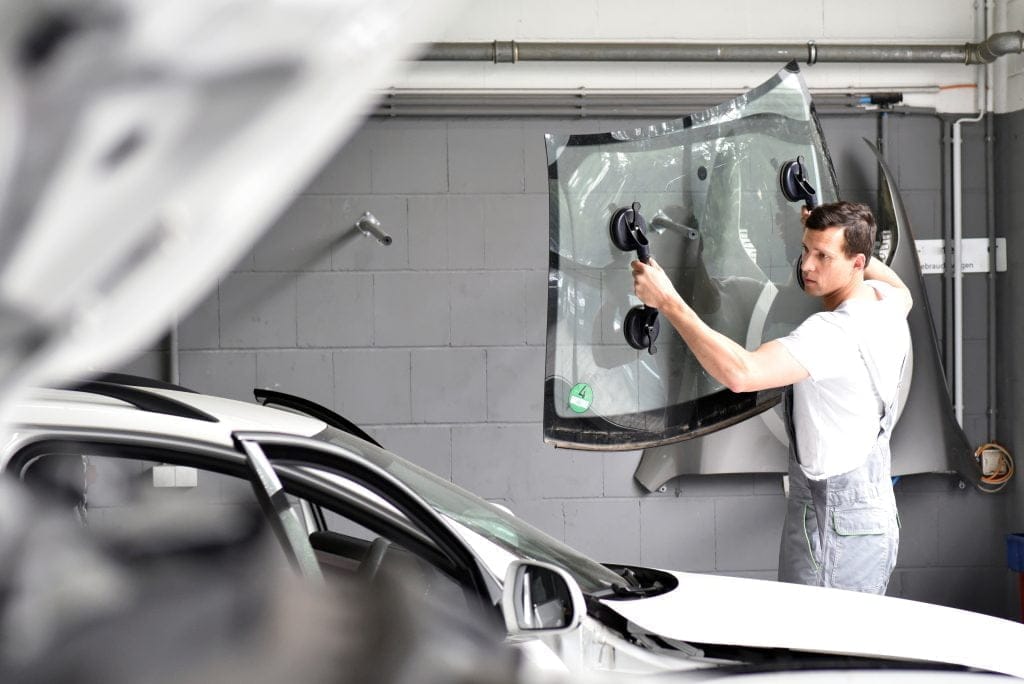
Twenty years ago, replacing a windshield meant removing glass and installing glass. On a lot of vehicles built in the last decade, it means something more, because there is a camera mounted to the inside of that windshield — and it is feeding the systems that decide when your car brakes for you.
This is the part of a windshield replacement that gets skipped most often, usually because nobody brings it up. Here is what it is and why it matters.
What ADAS Actually Is
ADAS stands for advanced driver assistance systems — the umbrella term for features that watch the road and intervene. Depending on the vehicle, that can include lane departure warning, lane keeping assist, automatic emergency braking, forward collision warning, adaptive cruise control, traffic sign recognition, and automatic high beam control.
Many of those features rely on a forward-facing camera, and on most vehicles that camera is mounted to a bracket bonded to the windshield, usually behind the rearview mirror. Some vehicles pair it with radar in the grille. The camera is what reads lane markings, identifies the vehicle ahead, and recognizes signs.
Why Replacing the Glass Breaks the Aim
The camera does not just see — it calculates distance and position based on where objects appear in its field of view. That math depends on the camera being pointed exactly where the manufacturer specified, within a very tight tolerance.
When a windshield is replaced, the camera is detached and reinstalled. Even if it goes back onto an identical bracket, small variances accumulate: slightly different glass thickness, a marginally different bracket position, a different bead height on the urethane. A fraction of a degree of aim error at the camera becomes a large error at distance.
What That Looks Like on the Road
The failure modes are subtle, which is exactly what makes them dangerous. The system does not usually shut off and tell you it is confused. Instead it works, but wrongly:
- Lane departure alerts that fire when you are centered, or stay quiet when you drift.
- Adaptive cruise control that follows too close or brakes earlier than it should.
- Automatic emergency braking that misjudges closing distance.
- Lane keeping assist that steers toward one side of the lane.
- Sign recognition reading the wrong speed limit.
A driver who has come to trust these systems is relying on a sensor that is now aimed slightly wrong, without knowing it.
The Two Types of ADAS Recalibration
Static Recalibration
Performed indoors with the vehicle stationary. Manufacturer-specified targets — printed boards with defined patterns — are positioned at exact distances and heights in front of the vehicle, on level floor, in controlled lighting. A scan tool puts the vehicle into calibration mode and the camera learns its reference points from the targets.
This requires real space, a genuinely level floor, correct targets for that make and model, and the right scan tool. It is not something that can be improvised in a parking lot.
Dynamic Recalibration
Performed by driving the vehicle under specific conditions while a scan tool is connected. The manufacturer specifies the requirements: a minimum speed held for a certain duration, clearly marked lanes, adequate daylight, dry conditions. The camera calibrates against the real-world road.
Some vehicles require static, some require dynamic, and some require both in sequence. The manufacturer defines it — it is not the shop’s preference.
Questions Worth Asking Before You Book
This is where a little directness up front prevents a problem later.
- Does my specific vehicle require recalibration after a windshield replacement?
- Is it static, dynamic, or both?
- Is recalibration performed in-house, or referred to another facility?
- Is it included in the quoted price, or billed separately?
- Will I receive documentation confirming it was completed successfully?
- Does the replacement glass support my vehicle’s camera and any heating or acoustic features it had?
That last one matters more than people expect. Windshields on ADAS-equipped vehicles often have specific optical requirements in the camera’s viewing area, along with features like acoustic interlayers, heating elements, or rain sensor brackets. Glass that is dimensionally correct but optically different in the camera zone can cause calibration to fail or produce marginal results.
Documentation Is Not Paperwork for Its Own Sake
Ask for the calibration report. A proper recalibration produces a record from the scan tool showing the procedure ran and passed. That document matters for three reasons: it confirms the work was actually performed, it gives you something concrete if a system misbehaves later, and if the vehicle is ever involved in an incident where an ADAS feature is relevant, its calibration history is part of the record.
If a shop cannot produce documentation, that is worth weighing seriously.
Other Things That Can Require Recalibration
Windshield replacement is the most common trigger, but not the only one. Suspension work that changes ride height, wheel alignment, front-end collision repair, bumper or grille replacement on radar-equipped vehicles, and even consistently carrying heavy loads that alter the vehicle’s attitude can all affect sensor aim. If a driver assistance warning light appears with no obvious cause, calibration is one of the things to check.
The Cost Question
Recalibration adds cost to a windshield replacement, and there is no way around that. Whether your insurance covers it depends on your policy, and that is a conversation for your agent rather than something we can answer for you.
What we would say plainly: declining recalibration to save money on a vehicle that requires it is not saving money on the same product. You are getting a windshield with a misaimed safety sensor behind it. If the budget is the constraint, that is worth discussing openly before the job rather than finding out afterward.
Clear Choice Glass Can Talk Through Your Vehicle’s Requirements
Whether your vehicle needs recalibration depends on its make, model, year, and equipment. The right time to sort that out is before the glass comes out, so there are no surprises and no warning lights on the drive home.
Clear Choice Glass and Mirror provides auto glass repair and installation for drivers in Palestine, TX, and the surrounding area. Contact Clear Choice Glass or call 903-727-0425 and we will go over what your vehicle requires. If you are weighing whether you need replacement at all, our post on rock chip repair versus replacement is a good place to start.